
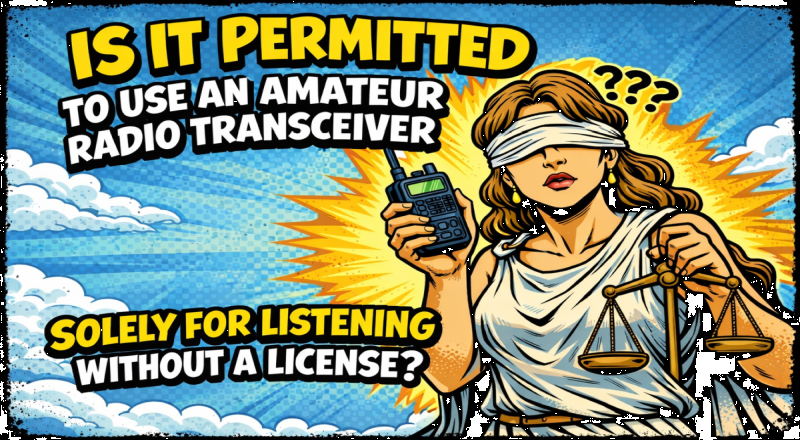
I am often asked whether it is permitted in Germany for a non–licensed radio amateur to own amateur radio equipment and to listen to amateur radio transmissions. The answer is very clear: yes, it is permitted—and not only in emergency situations.
In the forum afu-base.de I found an official response from the Federal Network Agency (Bundesnetzagentur, BNetzA) from 2016 regarding this question, which includes the legal basis as well as a thorough explanation. The following question was asked: “Is it permitted to use an amateur radio transceiver solely for listening without a license?” Attention: The legal situation may be completely different in other countries (for example in Austria, Switzerland, etc).
Quote:
The legal framework for the installation and operation of an amateur radio station is laid down in the Amateur Radio Act (AFuG) and the associated Amateur Radio Ordinance (AFuV).
According to these regulations, participation in the amateur radio service (AFuV § 9 para. 1) and the use of an amateur radio installation (AFuV § 9 para. 2) require authorization along with the assignment of a personal amateur radio call sign. An amateur radio station is a radio station consisting of one or more transmitting radio installations and receiving radio installations, including antenna systems and the auxiliary equipment required for their operation, and which can be operated on at least one of the frequencies allocated to the amateur radio service in the frequency allocation plan (AFuV § 2 para. 3). The ordinance therefore regulates only the operation of an amateur radio station; possession of and the technically ready installation of an amateur radio station are not regulated.
Furthermore, AFuV § 9 para. 5 states: Authorization to participate in the amateur radio service is not required for the reception of transmissions. Accordingly, you may actually put a technically ready amateur radio station into operation for the purpose of receiving transmissions. However, it is essential to ensure that misuse of the amateur radio station is excluded (AFuV § 16 para. 9). Any transmission operation (even briefly or for testing purposes) constitutes not only a violation of the AFuG but also of other legal provisions (e.g. the Telecommunications Act) and may be subject to legal penalties. In the event that your radio station is inspected by authorized persons, it is your responsibility to plausibly explain that you have operated the radio equipment only in a lawful manner.
Please note that the general permission to receive transmissions applies only to amateur radio transmissions. With a radio installation, only messages intended for the operator of the radio installation, radio amateurs, the general public, or an unspecified group of persons may be listened to. The content of other messages, as well as the fact that they were received, may not be disclosed to others—even if the reception occurred unintentionally—except in emergencies (§ 89 Telecommunications Act).
If you wish to conduct transmission operations before obtaining authorization to participate in the amateur radio service, you may do so under the guidance and supervision of a duly authorized radio amateur. In addition to their individual authorization to participate in the amateur radio service, the instructing radio amateur (not the trainee) requires a training call sign, which can be applied for at the Federal Network Agency. Training radio operations may also take place at your amateur radio station; however, the presence of the trainee radio amateur must be documented in writing (station logbook) (§ 12 AFuV).
If you have any further questions, please do not hesitate to contact me.
Yours sincerely,
Ralf Bürger
Federal Network Agency
Dortmund Branch Office
Head of Service Center 10
(Amateur Radio Administration)
Alter Hellweg 56
44379 DortmundTel.: (0231) 9955–214
Email: Dort10-Postfach@BNetzA.de